Keser Security Operations is a practitioner-founded security firm. 25 years of hands-on SecOps experience — built through real incidents, real infrastructure, and real decisions under pressure. AI has changed what attacks look like and what your employees are already doing. That's exactly the threat environment our platform and methodology were built for.
Most security consultants start with a certification and a framework. We started with a problem: how do you build enterprise-grade security operations on real hardware, with open-source tooling, in an environment where you're the only practitioner?
The answer was a custom-built security operations platform for zero-trust networking, continuous traffic monitoring, behavioral analytics, and runtime security. In less than a year of production operation across multiple sites and countries, we learned what breaks, what scales, and what actually catches threats versus what just produces noise.
AI has changed what attacks look like and what your employees are already doing. We use the same tools your team uses — which means we know firsthand where they create exposure, where data moves, and what an attacker can leverage. That operational familiarity is built into every engagement. Not as a separate service. As the work itself.
Keser Security Operations is the declaration that this platform and methodology is ready to serve clients. We're not preparing to launch. We're operational.
Our security operations platform runs across physical PoPs in Northern California, Pachuca MX, and St. Louis MO, with cloud nodes available globally via AWS. It has handled real traffic, real failovers, and real incidents.
We use the same AI tools your employees are using — which means we understand specifically where they create exposure, where data moves, and how attackers can leverage them. Not from a framework. From daily operation.
Complexity is a security risk. Every architecture decision we make prioritizes the simplest solution that achieves the security outcome. Simple systems are easier to audit, easier to monitor, and harder to exploit.
Every tool in our stack is one we can explain, one we can show you, and one you can verify independently. No proprietary lock-in, no mystery boxes.
| Capability | Technology | Role |
|---|---|---|
| Zero-trust mesh networking | Tailscale | Every device authenticated; every connection encrypted |
| Egress enforcement | iptables + policy routing | Fail-closed: if the tunnel drops, traffic stops |
| Network traffic analysis | Zeek | Protocol analysis and logging on all egress traffic |
| Behavioral analytics | RITA | Beacon detection, C2 identification, long-connection analysis over DuckDB telemetry |
| Runtime security | Falco | Host-level anomaly detection and syscall monitoring |
| Infrastructure automation | Ansible | Repeatable, auditable configuration management |
| Data lake / analytics | DuckDB + Parquet | Fast querying over large telemetry datasets |
| Cloud egress / HA failover | AWS EC2 | Automated failover target when hardware nodes lose connectivity |
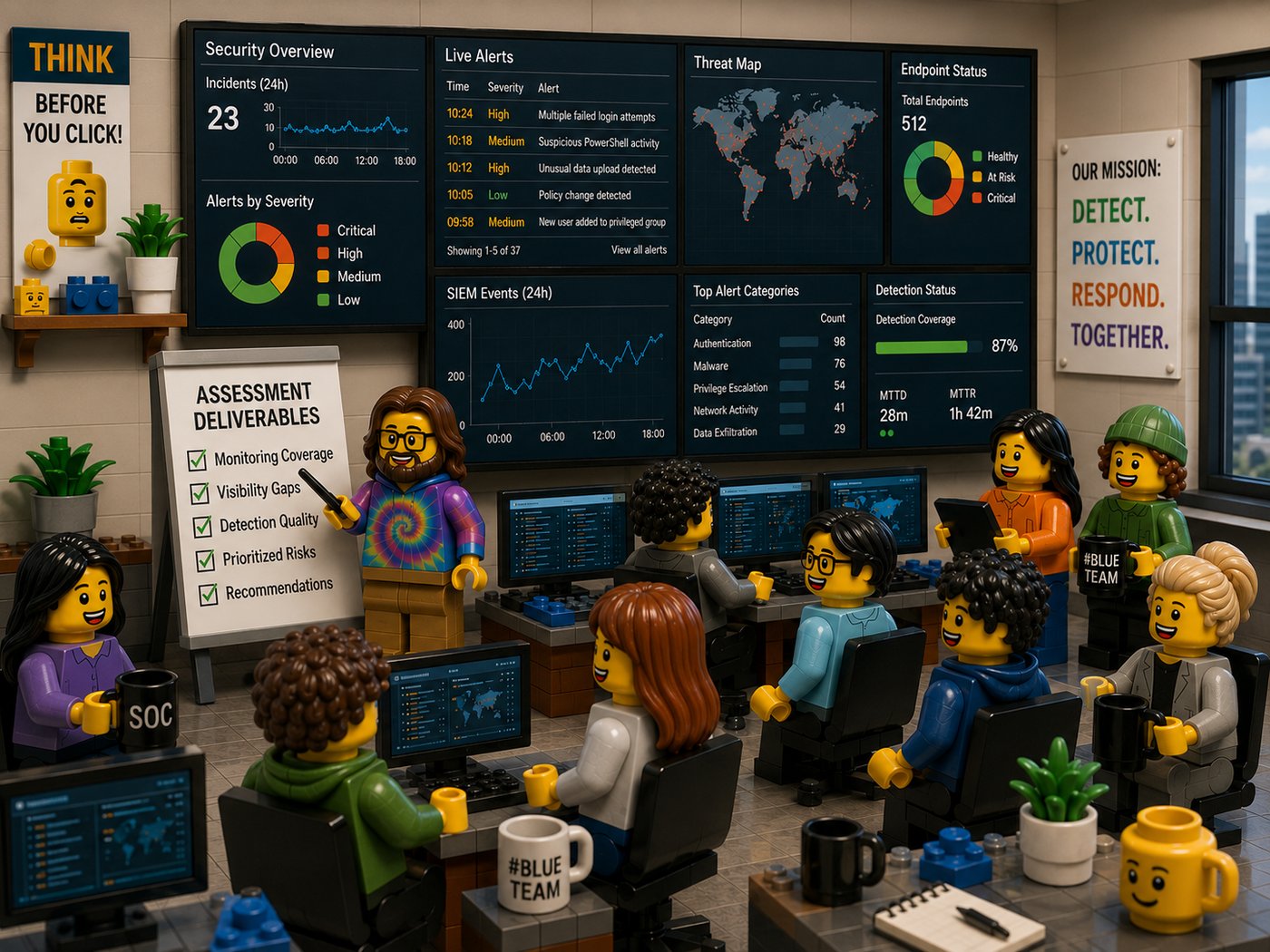
Every Fractional SecOps engagement starts with an assessment. We don't operate from guesses. You need a documented baseline before monitoring has meaning.
Security reports that only a practitioner can read aren't security reports. They're job security theater. Every deliverable we produce has an executive summary a non-technical stakeholder can act on.
We don't deliver findings without evidence. Every risk in an assessment report has supporting telemetry. Every alert we escalate has a documented investigation trail. You see exactly what we see.
Complexity is a security liability. The simplest architecture that achieves the security outcome is almost always the right architecture. We push back on unnecessary complexity, in our systems and in yours.
Most clients start with a Security Assessment — the fastest way to understand your AI exposure, monitoring gaps, and where your security posture actually stands. No long commitment. No vendor pitch.
Get in Touch